
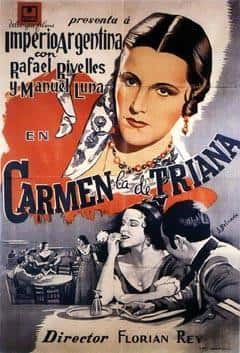
Carmen, la de Triana
Original title: Carmen, la de Triana / Andalusische Nächte
Direction: Florián Rey / Herbert Maisch
Production: Hispano Film Produktion and Universum Film Aktiengesellschaft (UFA)
Nationality: Spain and Germany
Year: 1938
Format: Fiction
Keywords: adaptación literaria, España (Andalucía), Gitanos, mito de Carmen
Duration: 1h 50m
Romipen: No
Sinopsis:
Carmen, a Romani woman, is a singer in a café in Seville. On a visit to the bullfighter Antonio Vargas Heredia, who is imprisoned for a quarrel in which Carmen was involved, she meets the brigadier José Navarro, who falls madly in love with her and follows her in her life as an accomplice of the bandits. However, when Carmen realises that José longs for his former life, she separates from him without offering any explanation, a gesture that the former soldier cannot comprehend, and which ultimately leads him to depart from the band of outlaws. Encouraged by jealousy, he attends the bullfight where Antonio Vargas Heredia dies and later dies himself by alerting his former military comrades to an ambush. Carmen, aware of the cruel fate that accompanies all those who love her, tries to fight against it to no avail and is left alone at the end of the story.
Critical comment:
The endeavour to film under the protection of the Third Reich in the UFA studios helped the collaboration between the director Florián Rey and the actress and singer Imperio Argentina to approach the myth of Carmen and give it a new perspective. Departing from the exoticism typically associated with the depictions of bandits and “gypsy” women in European Romanticist literature and art, this rendition of Carmen embodies the feminine values of strength and freedom. The film’s depiction of Carmen as a woman is characterised by her strength of character, which distinguishes her from previous incarnations, particularly those based on the femme fatale archetype. Imperio Argentina’s interpretation portrays a resilient spirit, intertwined with her free and “gypsy” identity, which evolves into a more nuanced character as the narrative progresses. She comes to understand herself in her love, defying the fatal destiny that haunts her, as foretold by “gypsy” witchcraft, infused with romantic and expressionist elements. Beyond the expectations of the myth, this Carmen is portrayed as unrestrained and firm in the pursuit of her desires. However, she is also depicted as responsible for her actions and will not be the object of the punishing death of her unredeemed personality as portrayed in the novel and the opera. Instead, she is portrayed as the surviving victim of an irrational and unknowable fate that has little to do with differences of race, gender or class.
Furthermore, a significant part of its rich identity can be attributed to its musical expression, which serves as a sentimental and dramatic echo of its well-known story. This is also the sub-genre of the film that follows the universal knowledge of the opera of the same name. The soundtrack draws from the contemporary Spanish popular music of composer José Muñoz Molleda. The bulerías and zambras (especially “Los piconeros” and “Antonio Vargas Heredia”) written at the same time by Juan Mostazo with various lyricists, were an unprecedented success and form part of the imaginary of the copla, of which the trace of its popularisation in this film has been lost.
Bibliography:
- Sylvia Zierer: “Carmen, la de Triana”, in Antología crítica del cine español. 1906-1995 , Madrid, Cátedra y Filmoteca Española, 1996, pp. 111-118.
- Marta Muñoz Aunión, “El cine español según Goebbels: Apuntes sobre la versión alemana de Carmen, la de Triana”, in Secuencias. Revista de Historia del cine , nº 20 (2) (2004), pp. 25-46.
- Eduardo Rodríguez Merchán y Joanna Bardzinska, “Carmen, la de Triana”, in Diccionario del cine iberoamericano. España, Portugal y América , Madrid, Sociedad General de Autores y Editores, 2011, pp. 273-275.
- Xavier Andreu Miralles: Xavier Andreu Miralles: El descubrimiento de España. Mito romántico e identidad nacional , Barcelona, Taurus, 2016, pp. 87-113.
- Manuel Nicolás Meseguer: Hispano Film Produktion. Una aventura españolista en el cine del Tercer Reich (1936-1944) , Santander, Shangrila, 2017, pp. 192-211.
- Laura Miranda: Laura Miranda, Canciones en el cine español. Periodo de autarquía (1939-1950) ,Santander, Shangrila, 2018, pp. 77-96.
- Rafael Fernández de Larrinoa, “La música de Carmen, la de Triana (1938): las fuentes y el proceso creativo”, in Anuario musical, nº 76 (2021), pp. 151-180.
- David Lagunas Arias, “Anti-sociedad gitana. Aceptabilidad y esquizofrenia en el romanticismo, el franquismo y el multiculturalismo”, in Imago crítica: Revista de antropología, comunicación y estudios culturales, nº 8 (2022), pp. 177-188.
